
A firefighter career in Kenya can become much more than a job. It can become a lifelong profession built around saving lives, protecting communities, preventing emergencies and developing skills that can open opportunities in Kenya, Africa and the Gulf.

For many young Kenyans, firefighting begins with a simple dream.
They want to wear the uniform.
They want to help people.
They want to respond when others are afraid.
However, professional firefighting requires much more than courage.
A firefighter needs training, discipline, physical fitness, teamwork, communication skills and practical experience. In addition, the modern firefighter needs to understand technology, hazardous materials, rescue, emergency medical response, fire prevention and Incident Command.
There is also another important reason to prepare now.
Kenya is developing major energy, petroleum and industrial projects. The proposed development of major petroleum infrastructure, including the planned refinery project in Lamu, could create a need for specialized fire protection and emergency-response services. A proposal for the Government of Kenya specifically identifies industrial firefighting, Emergency Response Teams, HazMat response, rescue, fire prevention, fire safety inspections, emergency preparedness and Incident Command support as potential services for major projects.
These developments do not guarantee jobs.
Nevertheless, they show why Kenyan firefighters should start preparing for the future.
The opportunity may come later. Your preparation must start now.
Firefighting is one of the careers where your work can directly affect another person’s life.
A firefighter may rescue a child from a burning house.
Another may respond to a road crash.
Another may protect an airport.
Another may fight an industrial fire.
Another may help prevent a fire through inspection and public education.
Therefore, firefighting is not only about putting out flames.
It is about protecting life.
Buildings can be repaired.
Vehicles can be replaced.
Equipment can be purchased again.
A human life cannot be replaced.
For this reason, many firefighters choose the profession because they want to serve.
You may never know the name of every person you help.
However, your actions during an emergency can change a family’s life forever.
That responsibility makes firefighting a serious profession.
Firefighting is changing.
Modern cities are growing taller. Industries are becoming more complex. Airports are expanding. Energy systems are changing. Electric vehicles and battery systems are becoming more common. Large construction projects are creating new risks.
As a result, firefighters need more skills than before.
A modern firefighter may need knowledge of:
Therefore, young firefighters should not think only about their first job.
Think about the career you can build over 10, 20 or 30 years.

One of the biggest advantages of firefighting is the number of possible work environments.
County governments provide important fire and rescue services.
Firefighters may respond to:
If you are already working for a county fire service, value that experience.
Every emergency call teaches you something.
Every drill can improve your skills.
Every equipment check can improve your readiness.
Airport rescue and firefighting is a specialized career.
Airport firefighters prepare for aircraft emergencies, fuel fires, rescue operations and other aviation hazards.
They must be ready to respond quickly when required.
The work also requires strong teamwork and knowledge of airport emergency procedures.
That is why airport firefighting can provide valuable specialized experience.
Industrial firefighters work in environments such as:
Industrial facilities can contain fuels, gases, chemicals, machinery and complex systems.
Consequently, industrial firefighters require additional knowledge and training.
Firefighters may also serve military camps and defence facilities.
These environments require discipline, teamwork and strong emergency procedures.
A firefighter may protect personnel, buildings, vehicles and equipment.
Large buildings also require fire protection and emergency preparedness.
Fire safety professionals may work in:
Therefore, the fire profession has many career paths.
You do not have to remain a general firefighter forever.
As your experience grows, you can specialize.
Structural firefighters respond to buildings such as homes, offices, schools, hospitals, warehouses and hotels.
They need skills in:
Airport firefighters specialize in aviation emergencies.
Their training may include aircraft rescue, aircraft fire behaviour, foam operations, aviation fuel hazards and emergency procedures.
Hazardous materials can create fire, explosion, poisoning or environmental risks.
Therefore, HazMat firefighters need additional training.
Technical rescue may include:
These skills can make a firefighter more useful during complex emergencies.
Some firefighters move into prevention.
They inspect buildings.
They identify hazards.
They educate communities.
They support fire drills.
They help organizations improve emergency preparedness.
Prevention matters because stopping a fire before it starts can save lives.

This is one of the most common questions from young Kenyans.
The answer depends on the employer and the specific recruitment advertisement.
Some entry-level firefighter positions may accept secondary school qualifications, while other employers may require additional education or professional training.
Therefore, always check the current vacancy.
If you are a Form Four graduate, do not assume that you must wait many years before beginning your journey.
Instead, start preparing.
Improve your fitness.
Learn First Aid.
Study fire safety.
Learn teamwork.
Improve your English.
Look for legitimate firefighter training.
Then build practical experience.
Firefighter age requirements vary by employer.
A county recruitment notice may have different requirements from a private company.
An airport may have different requirements from an industrial employer.
A Gulf employer may have its own age and medical requirements.
Therefore, never assume that one age limit applies to every firefighter job.
If a vacancy requires applicants to be at least 21, you must meet that requirement.
If an employer has a maximum age, check the current advertisement carefully.
The important lesson is simple:
Check the actual vacancy before applying.
A firefighter may carry heavy equipment.
They may climb stairs while wearing protective clothing.
They may work in heat.
They may crawl through difficult spaces.
They may carry an injured person.
They may work while wearing breathing apparatus.
Therefore, fitness is part of professional readiness.
Build:
Do not begin training one week before an interview.
Make fitness part of your lifestyle.
Firefighters also need to take care of themselves.
Sleep properly.
Eat balanced meals.
Stay hydrated.
Avoid habits that reduce your ability to perform.
Learn to cook simple meals.
These may sound like small things.
However, firefighters who work away from home may need to manage their own daily life.
Firefighting is a disciplined profession.
A firefighter must follow instructions.
They must respect the chain of command.
They must wear the correct PPE.
They must maintain equipment.
They must arrive on time.
They must work as part of a team.
During a major emergency, poor discipline can create additional danger.
For that reason, employers look for people who can be trusted.
A good firefighter does not only have courage.
A good firefighter has control, discipline and judgment.
Large emergencies can involve many teams.
You may have:
Without organization, these teams can interfere with one another.
Incident Command provides a structure for managing the emergency.
A firefighter should understand:
Therefore, Incident Command knowledge can help both your career and your emergency performance.
Question: What would you do if you received an order during an emergency?
Answer: I would listen carefully, confirm that I understand the assignment and carry it out according to the incident command structure. If I identify an immediate safety concern, I would communicate it through the proper chain of command.
This answer shows teamwork, discipline and safety awareness.
Preparing for an interview is important.
However, do not memorize complicated answers.
Understand the principles.
A strong answer could be:
“I want to become a firefighter because I want to save lives, protect people and develop professional emergency-response skills.”
“Life safety is my first priority. I would follow the incident command structure, assess the situation and work within my training and assigned role.”
“I would report to the incident commander, receive my assignment, wear the required PPE, assess hazards and perform my task according to training and procedures.”
“Incident Command is a system used to organize emergency operations, responsibilities, communication and resources.”
“I would clarify the instruction. If I believe there is an immediate safety concern, I would communicate it through the proper chain of command.”
“I would address the unsafe action according to procedure and inform the appropriate supervisor when necessary.”
“I am disciplined, willing to learn, physically prepared and committed to teamwork and public safety.”
For many Kenyan firefighters, international employment is an important career goal.
The Gulf has large airports, industrial facilities, ports, energy projects, hotels and major developments.
However, each employer has its own requirements.
A posted Serco Saudi firefighter vacancy, for example, listed two to five years of fire and rescue experience, including two years as a firefighter, along with medical fitness and qualifications including NFPA 1001 Firefighter I and II, NFPA 1072 HazMat Awareness and Operations, FEMA ICS 100, 200, 700 and 800, and First Aid or BLS.
Another Serco structural firefighter posting included qualifications covering Firefighter I and II, airport firefighting and HazMat response.
These are examples of employer requirements, not universal rules.
Therefore, always read the current vacancy.
Experience is extremely important.
For some international firefighter jobs, employers ask for several years of practical experience.
For example, the REDA HAZARD CONTROL vacancy mentioned above requested two to five years of relevant fire and rescue experience.
As a practical career target, a young Kenyan firefighter can use the first two or more years to build strong experience before targeting suitable international positions.
During that time:
Do not waste your early years.
They can become the foundation of your international career.
The exact certification requirements depend on the employer.
However, firefighters may encounter standards and training areas such as:
Saudi Civil Defense materials also reference NFPA standards relating to Firefighter, Fire Officer and Technical Rescue qualifications.
Therefore, certification should be planned around your target career.
Do not simply collect certificates.
Build real skills.
Young firefighters can explore recognized training institutions in Africa.
One training option that has been discussed for young people is Rescu-Life Africa in Pretoria, South Africa.
Before enrolling, confirm the current course duration, entry requirements, accreditation and certification directly with the institution.
Course details can change.
Likewise, one course does not automatically qualify you for every international firefighter job.
Always compare your training with the requirements of the jobs you want.
This is where the future becomes particularly important.
Kenya is developing major infrastructure in energy and other industrial sectors.
The proposal for a specialized industrial firefighting and emergency-response service specifically identifies major petroleum and energy projects as an area where Kenyan capacity could be developed.
The planned refinery project in Lamu is identified in the proposal as a possible pilot.
However, the wider opportunity could extend to other major petroleum, energy, manufacturing and industrial projects.
Potential roles could include:
The proposal specifically identifies many of these professional categories as potential beneficiaries of a structured industrial emergency-response programme.
This means the future is not only about one firefighter vacancy.
It can involve an entire emergency-response workforce.

Petroleum facilities can present serious hazards.
These may include:
The proposal identifies these hazards as reasons for specialized emergency preparedness and response capability.
Therefore, industrial firefighters need more than basic firefighting knowledge.
They need specialist preparation.
A professional Emergency Response Team could support several functions.
Teams could support:
They could respond to:
They could also support:
These functions are included in the proposed industrial emergency-response model.
This is an important point.
Industrial emergency response can create opportunities for many professionals.
A project may need firefighters.
At the same time, it may need:
Therefore, even if you are not a firefighter today, emergency and safety training may create another route into the sector.
If you want to prepare for future industrial opportunities, consider developing skills in:
Understand industrial fire behaviour and emergency procedures.
Learn the hazards associated with petroleum facilities and fuel emergencies.
Build knowledge of hazardous materials awareness and operations.
Develop technical rescue skills.
Learn the risks of confined spaces and appropriate rescue procedures.
First Aid and BLS skills can be valuable.
Learn how to identify and reduce fire hazards.
Understand how risks are identified and controlled.
Build confidence in breathing apparatus operations.
Learn how emergency scenes are organized.
Clear communication can save valuable time.
These areas are reflected in the proposed Kenyan industrial firefighter development pathway.
This is one of the strongest messages for young firefighters.
If you wait until the vacancy appears, you may already be behind.
Instead:
Train now.
Build experience now.
Improve your fitness now.
Prepare your documents now.
Learn English now.
Study emergency command now.
Build your professional network now.
When the opportunity appears, you should be ready to apply.
If you are already working for a county fire service, your current job matters.
Do not think that county firefighting experience has no value.
Learn your fire engine.
Know your equipment.
Understand your local hazards.
Study the buildings in your area.
Practice rescue.
Participate in drills.
Learn prevention.
Improve your communication.
Ask experienced officers questions.
Most importantly, take on-job training seriously.
The proposal recommends a structured pathway that could help Kenyan firefighters move from existing experience into specialized petroleum and industrial emergency-response roles.
Your current station can become your training ground for the future.
International and industrial opportunities can require documentation.
Keep copies of:
A valid passport is especially useful if you are targeting international employment.
Most importantly, never use fake documents.
A fake certificate can destroy your reputation.
It can also put lives at risk.
Firefighter salaries differ widely.
Pay can depend on:
Therefore, there is no single salary for all firefighters.
An entry-level firefighter may earn less than an experienced Fire Officer.
Likewise, a specialized airport or industrial firefighter may have different opportunities from a general firefighter.
For this reason, do not choose firefighting only because you expect a particular salary.
Build a career.
With experience and additional qualifications, your options can grow.
Airport firefighting is one of the most specialized areas of emergency response.
Aircraft carry many people.
They also contain fuel and complex systems.
Therefore, airport rescue and firefighting teams must maintain the readiness required by their airport and applicable aviation rules.
Airport firefighters need specialized training and rapid response skills.
This is one reason airport experience can be valuable for firefighters who want to develop an international career.
The firefighter of the future will use more technology.
Thermal imaging cameras can help locate heat and people.
Drones can provide information from dangerous areas.
Digital systems can improve communication.
Modern breathing apparatus can provide useful operational information.
Electric vehicles and battery systems are creating new fire safety challenges.
Consequently, firefighters must keep learning.
Do not fear new technology.
Understand it.
Train with it.
Use it safely.
A firefighter can progress through different stages.
For example:
Firefighter → Senior Firefighter → Crew Leader → Station Officer → Fire Officer → Chief Fire Officer
Exact ranks differ between organizations.
You can also specialize in:
Therefore, your first firefighter job does not have to be your final position.
Keep learning.
Keep developing.
Keep serving.
Young firefighters should learn from experienced professionals.
Books, training programmes, drills and mentorship can all help.
The book In the Flames can also be used as a resource for learning about Kenyan firefighters and international fire service career experiences.
However, reading should support practical training.
Study the theory.
Practice the skills.
Learn from experienced firefighters.
Ask questions.
Then apply what you learn.
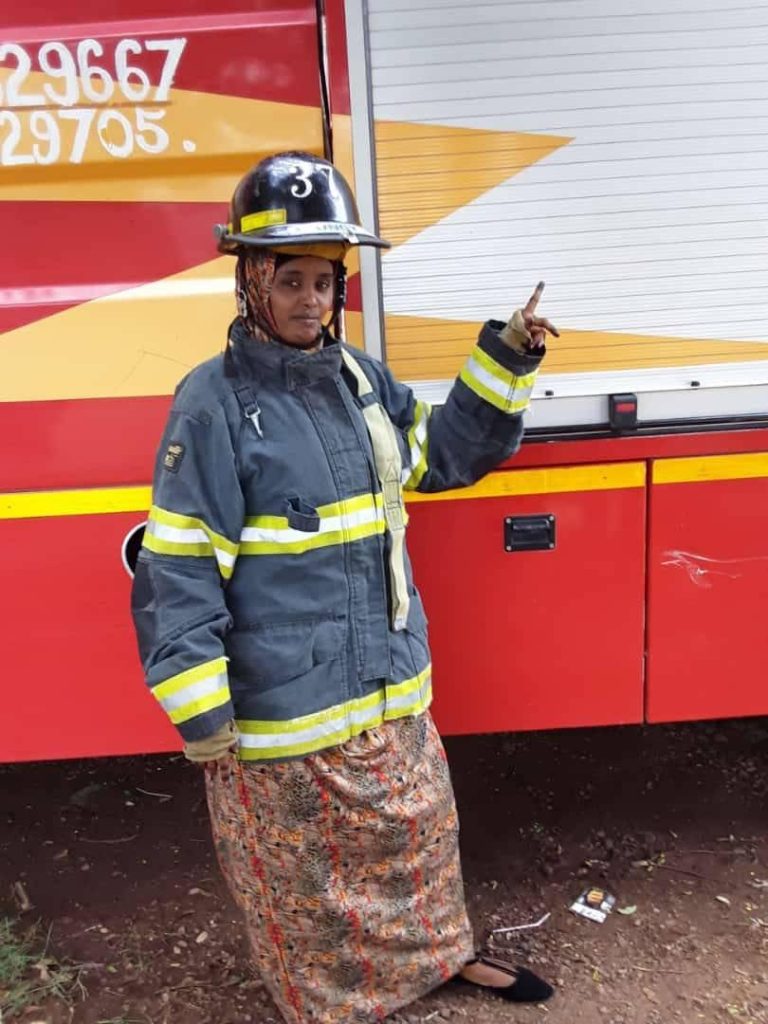
Young people today have many career choices.
Firefighting may not always be the first profession they consider.
However, it can provide a meaningful career based on service, discipline and professional development.
Do not see the fire service only as a uniform.
See it as a responsibility.
You may be called when a child is trapped.
You may respond to a road crash.
You may protect an airport.
You may work at a major industrial project.
You may enter a dangerous building while other people are escaping.
Therefore, preparation is essential.
If you are already serving, keep learning.
If you are waiting for recruitment, prepare.
If you are a county firefighter, build strong practical experience.
If you want to work in the Gulf, study the requirements of the jobs you are targeting.
If you want industrial firefighting, start learning industrial hazards.
If you want airport firefighting, pursue the training required for aviation emergency response.
If you want to become an officer, develop leadership and Incident Command skills.
If you want to become an instructor, strengthen your technical knowledge and communication.
There is a place for many skills in the modern fire service.
The proposed industrial emergency-response framework is built around a clear idea.
Major national projects should not only create infrastructure.
They should also help develop Kenyan technical capacity.
The proposal identifies employment creation, skills transfer, local content, public safety, economic development, reduced dependence on foreign labour and international competitiveness as potential benefits.
That is why the coming industrial projects deserve attention from Kenyan firefighters.
They can become training grounds.
They can become career pathways.
They can create specialist companies.
They can develop local expertise.
They can help Kenya build a stronger emergency-response system.
The proposal identifies Lamu as a possible pilot location for an industrial emergency-response model.
The suggested process includes:
The goal would be to learn from the pilot and develop a model that could be used for other petroleum and industrial projects.
However, this should not be understood as a promise that particular jobs will be created.
Actual employment will depend on project development, approved structures, contractors, recruitment decisions, qualifications and applicable laws.
That distinction is important.
Prepare for the opportunity without selling false promises.
Imagine a young Kenyan firefighter beginning today.
They complete their education.
They improve their fitness.
They join a fire service.
They gain practical experience.
They learn First Aid.
They study HazMat.
They learn Incident Command.
They develop rescue skills.
They gain recognized certifications.
They maintain a professional CV.
Then a major industrial opportunity appears.
That firefighter is not starting from zero.
They are ready.
This is the message I want young African firefighters to understand.
Do not wait for the opportunity to prepare. Prepare for the opportunity before it arrives.
If firefighting is your goal, follow a simple path.
Meet the education requirements of your target employer.
Train consistently.
Start with First Aid, CPR and fire safety.
Choose legitimate training providers.
Take your current fire service or emergency role seriously.
Consider airport, industrial, HazMat, rescue or prevention skills.
Understand how major emergencies are managed.
Keep your passport, certificates and experience letters ready.
Check official employers and recognized recruitment channels.
Practice technical, safety, teamwork and command questions.
A firefighter career in Kenya can start with a simple dream.
But dreams need preparation.
Study.
Train.
Stay fit.
Build discipline.
Gain experience.
Get genuine qualifications.
Learn emergency command.
Improve communication.
Understand prevention.
Develop specialist skills.
Then keep learning.
The future of firefighting will not belong only to the strongest person.
It will belong to firefighters who are prepared, trained, disciplined and willing to learn.
Kenya’s future energy and industrial projects may create new opportunities for firefighters and safety professionals. The proposed industrial emergency-response framework shows how those opportunities could extend beyond traditional firefighting into rescue, HazMat, fire prevention, emergency planning, training and Incident Command.
The Gulf and international market can also provide opportunities for firefighters who meet specific employer requirements.
Therefore, build your career in stages.
Start locally.
Learn your job.
Build experience.
Get the right training.
Develop specialist skills.
Then look internationally.
Do not chase certificates without skills.
Do not chase jobs without preparation.
Do not believe promises of guaranteed employment.
Instead, become the firefighter that employers can trust.
When the alarm comes, people need professionals.
When the project starts, companies need professionals.
When the emergency happens, communities need professionals.
Kenya needs firefighters who are ready for the future.
Africa needs firefighters who are ready for the future.
And the future starts with what you do today.
TRAIN TODAY. PREPARE TODAY. SERVE TOMORROW.
SAVE LIFE FIRST.
For firefighter career guidance, fire prevention education, emergency-response awareness, training information and fire safety resources, follow Fire Chief Wako and Mama Kabale Fire Safety Foundation.
Safety is love in action, every day, in every home.

One Response
As an ARFF crew member currently working in Dubai, I’m encouraged to see the growing focus on strengthening Kenya’s fire and rescue industry. There is a lot of potential for Kenya to develop world-class firefighting services through continuous training, modern equipment, international standards, and investment in professional firefighters. The future of fire safety in Africa depends on the knowledge and skills we build today. Proud to see conversations like this taking place, and I look forward to contributing to the growth of the industry back home.